Porto to Munich by bike and train.
I had never thought about doing bikepacking until I received an email from my university about the SET Journey Contest. In the examples, they mentioned bikes as one of the low-emission options we could use, and I asked myself, “Why not?”. There were many reasons not to do it, actually - especially safety concerns, since I would be a woman with no experience in bikepacking travelling alone. But after struggling a lot with fear and insecurities, and because I wanted to overcome them instead of letting those reasons stop me, I decided to go - and it turned out to be one of the best decisions of my life.
I can’t tell you how to make a perfect plan for a trip like this, because I’m not the best at planning trips - actually, I hate doing that - but I can tell you how to do it without a very well-structured plan, and why this is the best way of doing it. Of course, I had a basic idea of where I wanted to go and how I wanted to do it, especially because I needed a plan to apply
for the SET Journey Contest, but the truth is that I changed most of the initial plan during the trip - and that’s is the best and worst part of travelling by bike.
The best part because you have the freedom to change along the way. You can decide that actually you want to stop in some city instead of continuing cycling that day because you liked that place, or because you meet some nice people and want to stay longer. The worst because sometimes you planned to cycle a certain number of kilometres that day, but in the end, it started raining heavily, or you got very tired, or it was already getting dark, and you needed to stop and find a place to sleep where you were. It’s a big exercise in learning to accept the things you cannot control, and in dealing with expectations and frustrations. In the beginning, it was hard, but in the end, I can see how much I learned from it.
The journey itself
The plan I made for the SET Journey Contest involved three steps:
1. Go from Porto to Santiago de Compostela by bus in the morning, in a journey that
would take between two to three hours.
2. After staying one night there, the plan was to start cycling north, following the
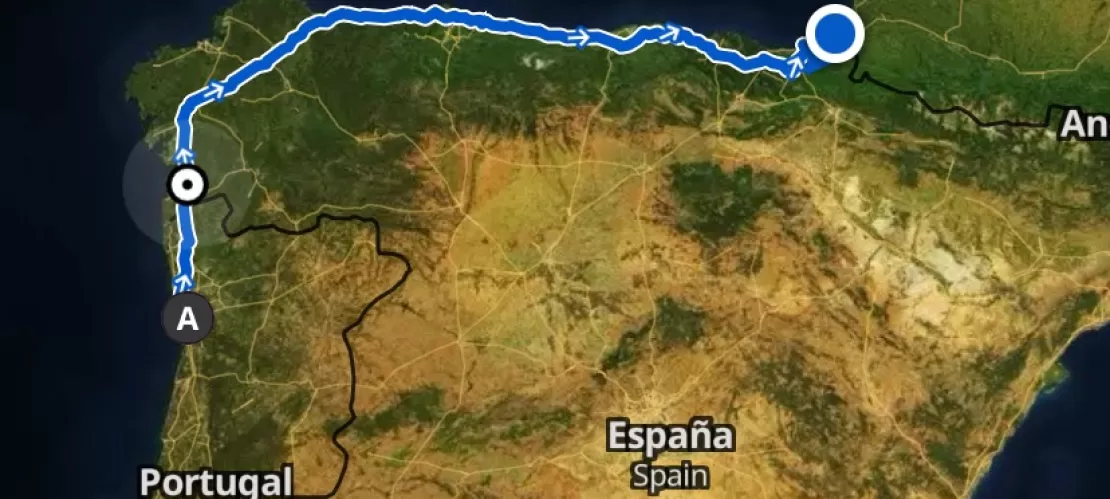
northern coast of Spain until France, and then continuing to Nantes.
3. In Nantes, I would take the train to Munich.
All these steps would be completed in 25 days, cycling 70 km per day - but in reality, it didn’t happen like that.
Two days before leaving Porto, I was trying to make a more detailed plan for the trip, but doing some research, I saw that it would be raining a lot in northern Spain in the following weeks. Afraid of not being able to cycle in the rain, I tried to find new routes, and I discovered the Camino Francés, a pilgrimage route that also goes from France to Spain - I would be doing it in the opposite direction. But there was a problem: part of Camino Francés was closed because of the strong fire season that hit Spain this year, as a consequence of climate change and extreme weather.
As I mentioned before, I don’t like planning trips, and I was getting overwhelmed trying to decide between going along the coast and dealing with the rain, or taking the Camino Francés and waiting for it to reopen by the time I arrived there. In the end, I decided to go from Porto to Santiago by bike instead of taking the bus, so I would have two days of cycling and plenty of time to think about which way to go. Two days after that decision, I left Porto with no plan of where I would sleep that night.
The first day was a mix of an amazing feeling of “I’m really doing it, I can’t believe it” - I was really proud - and fear and frustration, as I started to realise how hard it was to cycle so many kilometres in a single day. The following days were both challenging and amazing, and I am really happy that I made it. After three days, I crossed the border between Portugal and Spain, and after five days, I arrived at Santiago de Compostela. There, I decided to follow the initial plan of going along the coast, because I really wanted to spend some time close to the ocean before moving to Munich. I cycled through Galicia, Asturias, Cantabria and País Vasco, until crossing the border between Spain and France.
It was 25 days of cycling, covering a total of 1127 km from Porto, in Portugal, to Saint-Jean-de-Luz, in France. The initial goal of cycling to Nantes was changed to Bordeaux since I started to cycle from Porto and wouldn’t have enough time to go that far. Upon arriving in Saint-Jean-de-Luz, I met a very nice group of Germans with whom I had a great time. After three nights together, they offered me a ride to Bordeaux - they were also going there by van - and I accepted. We spent two more nights travelling along the France coast until they dropped me off in Bordeaux. From there, it was time to catch a train to Paris, where I stayed for three nights with a friend who is doing an Erasmus there - this decision was made one week before. From Paris, I took a train to Stuttgart and then a train to - finally - Munich!
What is the impact of this journey on the environment?
The total flight footprint from Porto to Munich is 0,19 tonnes of CO2 emitted, according to the Erasmus Goes Green calculator. When we look at the options I chose for this journey we have:
1. Bikepacking footprint from Porto to Saint-Jean-de-Luz: 0,00 tonnes of CO2
2. Carpooling from Saint-Jean-de-Luz to Bordeaux: 0,03 tonnes of CO2
3. Trains - Bordeaux - Paris (497 km), Paris to Stuttgart (500 km), Stuttgart to Munich (189 km): 0,01 tonnes of CO2
In total, during a trip that lasted 31 days, an average of 0,04 tonnes of CO2 was emitted, representing a 78,95% reduction in CO2 emissions compared to flying.
Was it worth it?
Definitely yes! What was supposed to be only a sustainable alternative for travelling became one of the most touching experiences of my entire life. There’s something about bikepacking that is different from all other ways of travelling: the state of presence.
While travelling by bike, I noticed that some parts of the road smelled like honey, and, on rainy days, the air smelled of wet wood. I could see all the animals - from little insects on the ground to wild rabbits, cows and horses. Everything moved slowly and quietly. And the views... Sometimes I found myself laughing alone because I was so happy with what I was seeing with my own eyes. Other times, I was so immersed in the landscape that it felt like entering a meditative state.
Bikepacking taught me how to deal with loneliness. I spent so much time alone that it was impossible not to learn that. Of course, I met a lot of people along the way - some of them I still talk to, some are just good memories I want to keep in my heart - but if you go bikepacking alone, you will be alone in a lot of moments. It is part of your journey!
Now, after living in Munich for 24 days, I can see how important that was for me. When you move to another country, it takes time until you find people that really match with you and form true friendships. After spending so much time alone before arriving here, I see that I can deal better with this period much better - with no rush to make all the friends right away, and feeling okay about exploring the city alone and getting to know people in a more natural way.
Bikepacking alone taught me a lot about myself, about my capacities and limits. It gave me time to think about life and to deal with things that I hadn't had time before. It gave me the opportunity to freely explore the places around me. I feel more confident about myself and my decisions.
And I truly believe this was an amazing process to go through before my Erasmus - it gave me the opportunity to start this new chapter of my life in the way I wanted: with confidence, presence, calm, motivation, and in a deeper connection with myself.