How it started
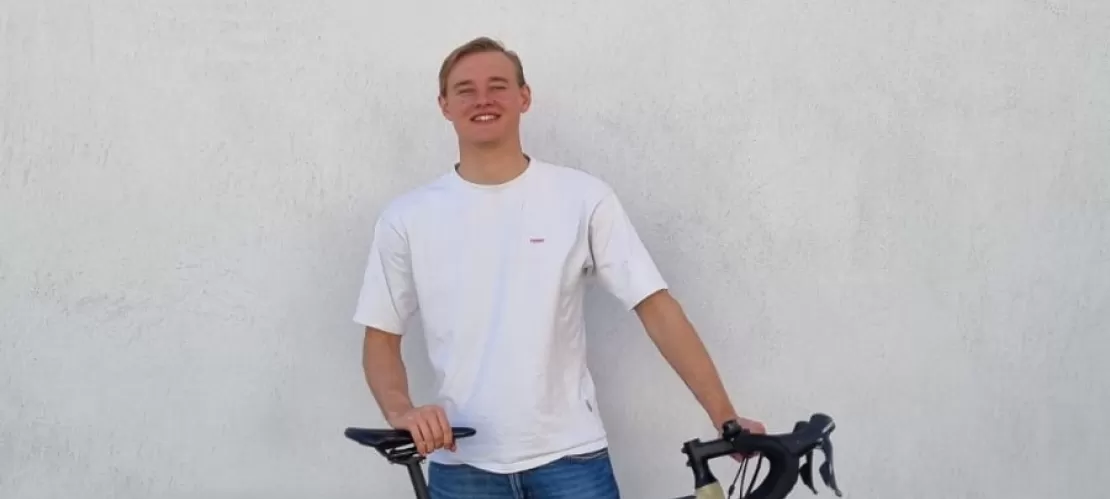
I was never really a great fan of doing long-distance travelling by bike (yes, even with my Dutch genes), but I love to challenge myself. As such, this idea of travelling from Rotterdam to Porto by bike started out as a joke between my friends and me. But unlike most ridiculous ideas that get proposed by my friends, this one stuck to my mind for multiple reasons. For starters, I was certain I did not want to travel by plane, which I have elaborated on in the next paragraph. Additionally, I knew it was possible in terms of conditions, distance, and the time I had for travelling (~1200km by bike, ~800km by train, 2 weeks of holidays). Lastly, it was a great way to discover countries I was not familiar with in an affordable way!
My reason for not wanting to fly is a little more nuanced than for most people. Of course, there is the obvious reason of trying to limit my carbon footprint by not flying. However, since my parents moved to Thailand when I was 19 years old, I have to make a long-distance flight every time I wish to visit them. This gives the impossible choice between not flying anymore and not seeing your parents anymore. As I visit them once a year, I want to avoid flying for the remainder of the year. Therefore, I was motivated to try to travel to Portugal in the most sustainable way
possible.
Now, you might be asking, “travelling to Portugal by bike in February, you must be insane!!!”, which is a fair thought, and honestly was my first reaction to the idea. However, being well prepared for cold temperatures and rough conditions turns it from a crazy idea to a fun, safe and doable adventure!
Planning the journey
The largest part of planning the journey consisted of purchasing the bike, planning the route, and thinking about all of the things that could possibly have gone wrong (which are many if you’re unprepared!!). As I had only gone camping once in my life, I would have never been well prepared without advice from friends and family (many of whom called me crazy). Additionally, planning the trip was a fun activity to do! Every time you check something off the checklist, the realization you are actually going to go on this trip increases.
As I had two weeks between my exams in Delft and the start of the semester in Porto, the final plan was to cycle ~120km per day on average with two rest days. An experienced cyclist might immediately notice that this is a little ambitious for someone who has never done such a trip before and is much heavier than a regular cyclist due to the luggage. I however, not being the aforementioned, thought it was a great plan. Although I altered the plan slightly when on the journey, this immediately proved the benefits of great independence and flexibility by travelling
by train, bus and bike.
The journey
Since I had exams until 2 days before departure, the nerves only started the day before stepping on the first train. However, after surviving the bike-trip from my house to the train station (the first ~2.5km) with my way-too-fully packed bike, I felt confident about actually being able to cycle with all of my luggage. My planned itinerary started by travelling by train from Rotterdam to Orleans through Paris, and starting my cycling journey there. However, the first challenges with this plan arose when trying to reach Paris with my fully packed bike from Lille; it turns out that you cannot bring your bike on this route with the train I had booked my ticket for (of course this was an unavoidable mistake, never heard of “the internet” apparently...). Pro-Tip: Check the bike-on-train rules before you book! Hence, the only option I had was to book a bus to Paris, and mark the bike as “large luggage” when booking the ticket. At first, the bus driver did not look amused (at all) at the “clumsy” shape of my luggage, but in the end, I was allowed on the bus and could continue my journey. From there, I continued my journey to Orleans by train.
Next up: travelling from Orleans to Porto! After some practice with the clicking shoes for the bike (practising had, of course, been too much of an effort to realize BEFORE leaving), I was ready for the first day of cycling. Luckily, I love listening to podcasts, and have downloaded virtually unlimited hours of podcasts. Besides, although it was a little bit rainy, the scenery through France’s farmland was amazing (yes, even in February!). However, after the first day, which was my first experience of cycling 120km in a day with barely any altitude change, I came to the swift conclusion that my route might have been a little bit ambitious for the time that I had. But, one of the great perks of bikepacking by yourself: you decide the plan! Since I did not feel like hurrying from place to place to arrive on time for the semester, I decided to take another train, from Poitiers to Bayonne. So, after enjoying the lovely views along the Loire River from Orleans to Poitiers, I treated myself to the extra train trip. Most trains in France actually allow you to take your bike with you on the train! You have to reserve a spot for your bike, but there is enough space for the bike, including luggage.
From Bayonne to Bilbao, I was accompanied by the lovely sounds, smells, and beautiful views of the ocean. There are lots of bike paths that enable you to enjoy the views without fear of being hit by passing cars. However, although Spain has many roads where there are no bike paths, I noticed Spanish drivers are extremely respectful of the “1.5 meter rule”, defining the distance cars have to keep from you when overtaking cyclists, even though it felt like I was cycling in the middle of the highway the first couple of times. Nonetheless, it was lovely to explore these cities while on the trip!
From there, I again decided to alter my original plan (which went in an almost straight line to Porto), to a route that followed the Camino Santiago route through Léon and Sarria. If you love visiting museums, cathedrals and cities full of history like me, this is a great recommendation! The museums (many of them free for students) give an impression of the more than 1000 years of history along this specific route. Additionally, the large number of pilgrims doing the route in February is, amazingly, reasonably high compared to tourism in surrounding villages. Through hostels I shared with people walking the route, I made friends from Canada, South Korea, Germany and many more.
The last notion on the journey I want to make was the number of animals I saw along the way. From wild deer and foxes to beautiful birds. Also the beautiful views of cows roaming freely in the hills of northern Spain, with in the background the tops of the Picos de Europa, covered with eternal snow.
Where did you sleep?
This is a question I was asking myself for quite some time before departure. Sleeping in a hotel/Airbnb would have been too expensive for every night. Although hostels are cheap in big cities, and stops along the route of the Camino Santiago, I needed a plan for smaller villages. Would it not be too cold for sleeping in a tent? And if not; would it even be possible to sleep in a tent when all campsites are closed? Luckily, there are multiple applications that allow you to book a spot in someone’s garden to set up your tent in France. In Spain, this was more of a challenge. So, my genius plan was to just ask people whether I could set up my tent in their garden. And honestly, these turned out to be the most fun experiences of my whole trip!
The first time asking someone whether I would be allowed to set up my tent in their garden was in a small village in Spain, Pedrosa. I saw an old couple in their garden, grabbed my translator app, put my nerves aside, and asked. As expected, they first did not understand what I was asking of them. After it had become clear what I meant, they started discussing whether they liked the idea. Amazingly, they offered me a bed in their house in the living room! Thinking I’d already had the best moment of that day, they offered me to join them to meet their Dutch friends who lived in the same village. There, they gave me some food, some good wine, and communication was a lot easier, as the Dutch couple spoke Spanish. In the evening, they invited me to join them at the local bar, where they invited some friends to introduce them to me, bought me a warm meal, and to top it all off: a beer! Of course, this is the ideal outcome for a student trying to save some money. I was astonished by the sheer friendliness of these people, the Dutch couple and their friends. This truly changed my view of how hospitable people can be to strangers.
After the success of the first night, I tried again at the next stop. I went to the bar of the village and asked the bartender if he knew someone who had a garden available where I could put up my tent for the night. Since these are small villages (in winter, roughly 100 inhabitants), everybody knows everybody. Therefore, there was not a single moment when I felt unsafe. After the bartender asked the first person he thought of, I was, once again, offered a bed inside. Even though there was a language barrier, with modern translator apps, it was relatively easy to still have a conversation. It was super interesting to learn about these people’s stories, their families, and what life was like in these villages.
From there on, I stayed in hostels along the route of the Camino Santiago, which again was a fun opportunity to meet people from all over the world doing the pilgrimage route. As the road from Santiago de Compostela to Porto is also a Camino route, there were plenty of hostels along the way, which cost ~€14 per night on average.
What was the impact on the environment?
Since I had to take the bus from Lille to Paris, and decided to take an additional train, the carbon footprint of the trip turned out slightly higher than planned. All in all, the total emission according to the “Erasmus Goes Green” calculator amounts to:
1. Bus: ~223km (Lille Flandres -> Paris) – 0.02 tonnes of CO2e
2. Train: ~790 km (Rotterdam -> Lille Flandres; Paris -> Orleans; Poitiers -> Bayonne; Léon -> Ponferrada) – 0.02 tonnes of CO2e
3. Bike: 1200km – 0 tonnes of CO2e
For a total of 0.04 tonnes of CO2e.
This is ~four times lower compared to travelling by plane (0.17 tonnes of CO2e).
Arriving in Porto
After two weeks of travelling, 1200km of cycling, one flat tyre, two duct-tape-fixed bike bags, a lot of rain, breathtaking sceneries, and memories of amazing people, I finally reached the border of Portugal, which I crossed in Tui. From there it was only one more full day to my final destination: Porto! Happily, the ocean once again joined me as a travelling companion, which eased the last day into a pleasant, sunlit journey. Since my house is close to the Douro, I immediately crossed through a large part of the city before arriving at my exchange house.
Despite all of these good memories, although I will definitely do a bikepacking trip again, and recommend people to do the same, I would not do it again in February. It was a good challenge and gave much satisfaction upon completion, but nearly daily rain did make certain moments less pleasant than they had to be.
While writing this blog in the Library of the University of Porto and reflecting on this adventure, I notice I cannot help but physically smile. It certainly gave an extra dimension to my Erasmus exchange which I will never forget. Besides the beautiful things I have seen, what will especially live rent-free in my mind for the rest of my life is the beautiful people I met along the way, their kindness and hospitality. When one only reads the news, it is tempting to become pessimistic about people’s good intentions. This trip certainly has helped me reconnect with the “stranger” on the street, and sparked my interest in actually meeting locals, learning about their culture, only to find out that – despite our differences – people will just be people.