Think about the best learning experience you've ever had.
It probably wasn't a lecture or an exam. It was a conversation that challenged your perspective, a project where you learned by doing, or a moment when someone believed in your potential before you believed in yourself.
That's the power of non-formal education.
It is learning through experience, participation and reflection. It doesn't ask you to memorise the right answer - it encourages you to discover it yourself. Instead of listening passively, you become an active part of the process. And often, that's where the deepest learning happens.
Research increasingly supports what youth organisations have known for years: learning doesn't stop when we leave the classroom. The latest OECD Skills Outlook highlights lifelong learning as essential for adapting to a rapidly changing world, with 43% of adults across OECD countries participating in non-formal education or training within a single year.
But statistics only tell part of the story. The real impact of non-formal education is found in people.
Within the Erasmus Student Network (ESN), thousands of volunteers participate in workshops, training sessions and international events every year. They learn how to manage projects, lead teams, communicate across cultures and create meaningful experiences for others.
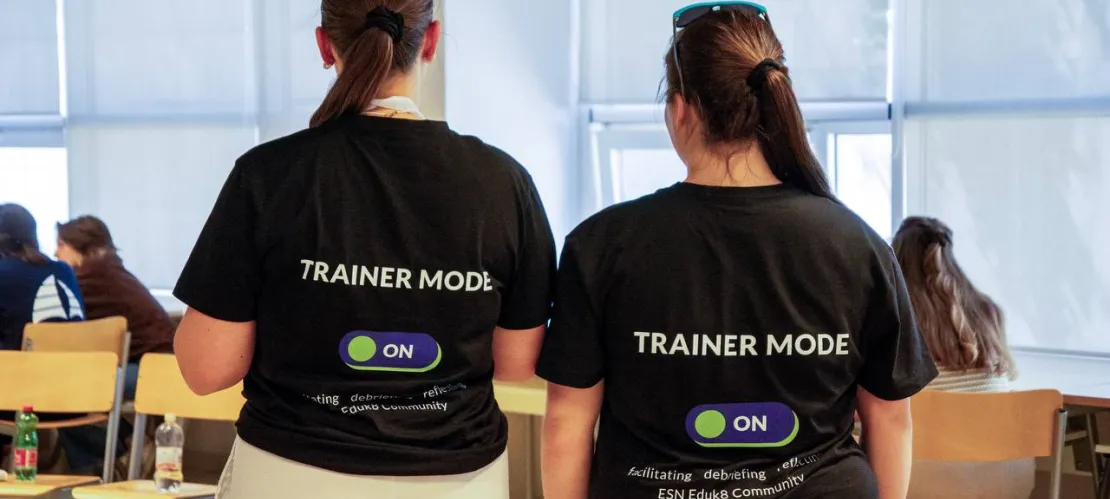
One of the paths of this journey is ESN Eduk8 - a programme dedicated to developing an international pool of trainers and facilitators who design and deliver educational activities using non-formal education methods.
Its mission goes beyond teaching workshop techniques. It creates educators, leaders and multipliers who bring learning back to their local sections, national organisations and international events, inspiring hundreds of other volunteers along the way.
Every workshop we facilitate becomes another opportunity for someone to grow. Ask an ESN Eduk8 trainer what non-formal education has given them, and the answer is rarely a certificate or a new line on a CV. Instead, they talk about confidence. About discovering that facilitation is not about standing in front of a room with all the answers, but about creating a space where others can find their own.
As one idea echoes throughout our ESN Eduk8 Community:
"It is not about you. It is about your participants."
That simple shift changes everything. Facilitators learn to ask better questions instead of giving immediate solutions. They learn to listen before speaking, to trust the collective wisdom of a group and to recognise that every participant brings valuable experiences into the room. In doing so, they often transform themselves as much as they transform others:
"ESN Eduk8 changed not only how I facilitate workshops, but how I communicate every day." - something that our trainers mention in their words about facilitation and ESN Eduk8.
But behind every experienced trainer is a first workshop. There was uncertainty. Imposter syndrome. Sessions that didn't go according to plan.
Yet almost every facilitator shares the same lesson: confidence is not built through perfection - it is built through practice. As one of our trainers highlights very well: "People may forget the activity you ran, but they'll remember how they felt during it, and what they discovered about themselves.”
Non-formal education creates a safe environment to experiment, reflect and improve. It encourages people to make mistakes, learn from them and come back stronger. That mindset extends far beyond workshops.
It appears later in the confidence to lead a meeting, the courage to challenge an idea respectfully, the ability to navigate diverse teams or the willingness to create opportunities for others. These are skills that shape careers and communities alike.
For many members of the ESN Eduk8 Pool of Trainers, facilitation became much more than a volunteer role. Some have become Learning & Development specialists. Others now facilitate professionally, work in coaching or organisational development, run their own businesses or have even established training centres. What started with a workshop became a career. But perhaps the greatest achievement is not professional success. It is the confidence to keep learning, adapting and empowering others to do the same. It may start with a workshop, which probably lasts a few hours. However, the learning lasts much longer.
Every facilitator who gains confidence helps participants discover theirs. Every participant inspired to grow may one day become a facilitator themselves. In this way, non-formal education creates a ripple effect that extends far beyond a single activity or organisation.
That is the strength of ESN Eduk8: it is not just about training - it builds a community of people who believe that learning is collaborative, lifelong and transformative. The stories of ESN Eduk8 trainers and facilitators are different, but they all lead to the same conclusion.
Non-formal education does more than teach skills. It changes the way people learn, lead and connect with others. It helps volunteers become educators, participants become leaders and experiences become lifelong lessons.
If you've ever wanted to inspire others, facilitate meaningful conversations or simply discover a different way of learning, this journey is possible together with ESN. Because sometimes the most important education is the one you never expected to receive.